

Product marketers are known for wearing many hats.
The problem today is that AI models have been trying these hats on as well—and discovering that they fit.
It’s okay to feel uneasy about this. AI can write a content brief. It can churn out your next battlecard. And it’s getting better at turning customer research into polished frameworks.
But while this has created some uncertainty, it’s also creating space for us to reinvent our careers and focus on more fulfilling work.
If the hats you’re wearing today are mostly executional—the kind that involve decks, docs, and deliverables—you might want to start creating a bigger role for yourself. It’s now easier than ever to step outside of the traditional PMM role and become a type of hybrid.
And my take is that this is also the best way to evolve in the age of AI. The PMMs that will continue to thrive are the ones who broaden their scope, deepen their influence, and move closer to the heart of the business.
This article explores how to do that—and why it’s not as daunting as it sounds.
The case for becoming a hybrid PMM
It’s pretty clear that we need to evolve in order to stay valuable as PMMs. AI isn’t going to replace us overnight, but it is becoming very good at many of our responsibilities.
As AI takes on more executional work, PMMs have a few options for how to adapt:
1. Keep doing the same things, but use AI to do them faster.
Use AI to generate content more efficiently. Repurpose messaging, write copy, spin up internal docs at speed. This is a productivity win, no doubt. But here’s the catch: everyone else can now do this too. A founder. A CSM. A sales leader. With AI, they can generate the same assets you can using a custom GPT or a prompt library. If your value is purely in output volume, you’re now competing with AI and AI-powered non-marketers.
2. Keep the same role, but take on more strategic work.
This is a powerful and completely valid path. You don’t need to hybridize to level up. You can go deeper within PMM and become the kind of person who:
- Shapes GTM strategy, not just executes it
- Owns market sizing, pricing, or segmentation
- Leads launches with clear business outcomes
- Brings original insight to leadership conversations
This is about becoming a decision-maker, not just a deliverable-maker. AI may help with inputs, but judgment, prioritization, and cross-functional influence still require a human.
3. Evolve into a “hybrid” role that overlaps with other functions.
This takes your strategic influence a step further, into another business function entirely. You keep your PMM foundation, but expand your authority in areas where you already have some influence—product, sales, enablement, community, etc. This isn’t about doing the work of two people. It’s about evolving your current one into something broader, more strategic, and harder to replace.
Now, I can already hear some protests against this last suggestion. Things like…
-
“But I’m too busy.” Hybridization doesn’t mean doing more work. It means swapping out low-leverage work for higher-leverage contributions. You don’t need to change jobs. You need to change how you show up.
-
“My company doesn’t support or want a role like this.” It doesn’t matter. This starts as a side project. Offer to support a late-stage deal. Join roadmap planning as a guest. Start small, show value, and earn trust. And if you really get told to stay in your lane, just take your skills and curiosity elsewhere.
-
“What if I just want to do PMM?” Totally fair. Some people just want to write great messaging or run killer launches. If that’s you, and you love it, go all in. Just make sure you’re amazing at it.
But I’m convinced that the hybrid route is the best way forward, at a very low-risk. You’re not quitting your job and going back to school. You’re just following your curiosity, finding new ways to make an impact, and taking advantage of new technology to drive this evolution.
Let’s look through some examples of what a hybrid role could look like for you—including a few that already exist at some of the leading tech companies.
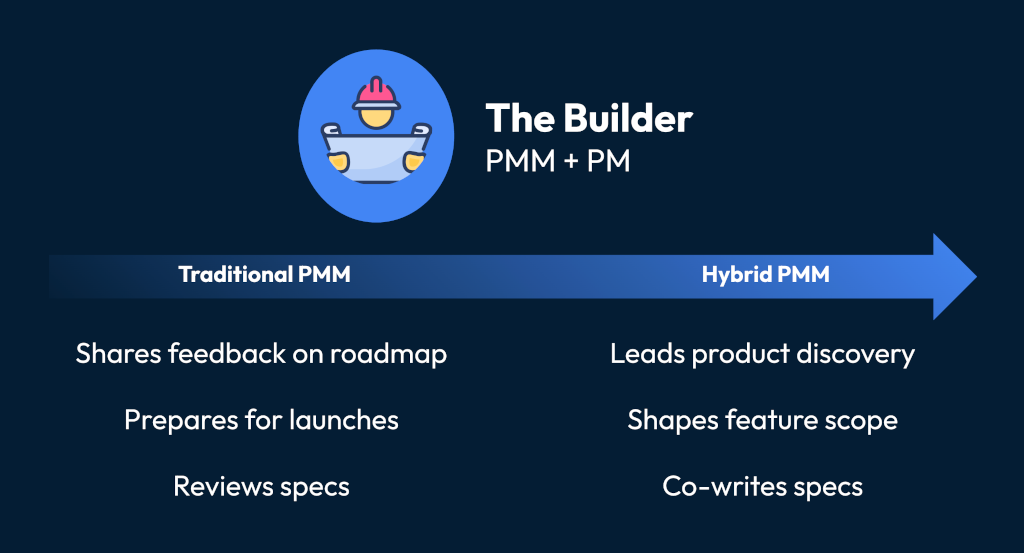
Path #1: The Builder (PMM + PM)
Best for: PMMs who want more ownership and love solving real user problems.
This is one of the most natural hybrid paths—especially if you’re the kind of PMM who can’t help poking holes in the UX or asking product questions in roadmap reviews. The role already exists at companies like Apple and Airbnb.
Product-minded PMMs are already halfway to PM. They think in terms of user flows, friction points, and feature value. They’re not just crafting the story of what was built—they’re influencing what gets built and why it matters.
Some eventually make the jump to PM full-time. But even if you don’t, you can carve out a niche as someone who plays a leading role in product development through a deep understanding of your customers, market, and sales cycle.
What this hybrid looks like:
- You participate in product discovery sessions
- You help spec and validate early feature ideas
- You run betas, collect user feedback, and shape v1 launches
How to break in:
- Learn product discovery basics (Teresa Torres, Marty Cagan, etc.)
- Ask to co-lead a feature launch, start to finish—including pre-build planning
- Become the go-to person for product/market fit questions
How to show your value:
- Pick feature launches that are connected to product-led growth or plan upgrades
- Play an active role in technical demos to gain visibility with your engineering teams
- Track revenue gained from any in-product activations or plan upgrades
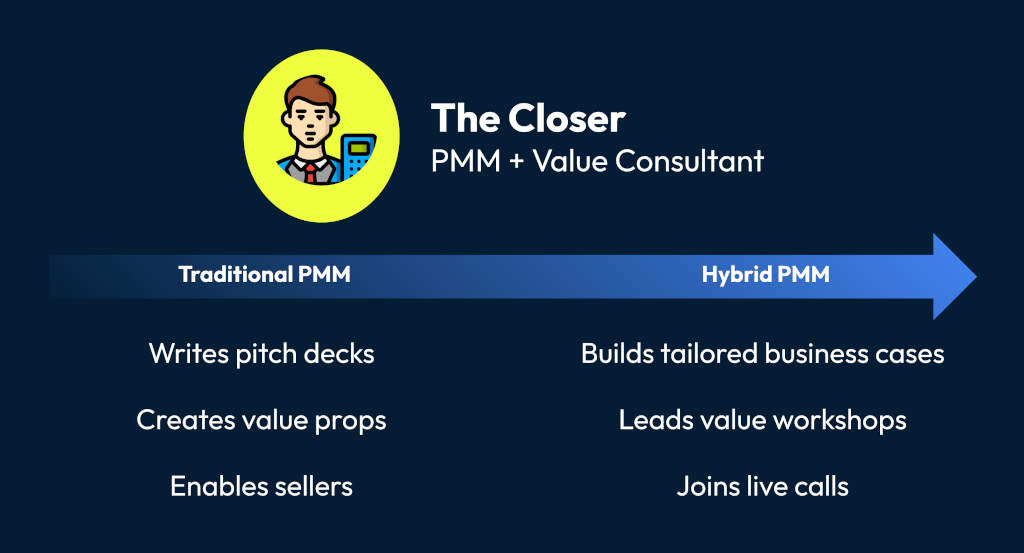
Path #2: The Closer (PMM + Value Consultant)
Best for: PMMs who love sales, storytelling, and ROI.
This is the path I accidentally found myself on.
I started working closely with sellers on large enterprise deals—building custom business cases, calculating potential savings, and sitting in on executive calls. The result? Deals moved faster. Sellers asked for my help more often. And I became a go-to resource for navigating high-value opportunities.
This role isn’t about updating a pricing slide. It’s about helping customers justify a $500,000 investment. You need to speak CFO. You need to tell a clear financial story. You need to be credible in the boardroom.
What this hybrid looks like:
- You own the value narrative for your product
- You work directly with sellers to create tailored business cases
- You run “value workshops” with customers, and present outcomes to their executives
How to break in:
- Shadow high-stakes deals, and offer messaging or presentation support
- Learn value-based selling frameworks (MEDDIC, Command of the Message), and lead enablement across your sales team
- Build a simple ROI model in Excel and road-test it with customers
How to show your value:
- Track total closed won ARR for deals you supported
- Share wins and learnings back to your Marketing team
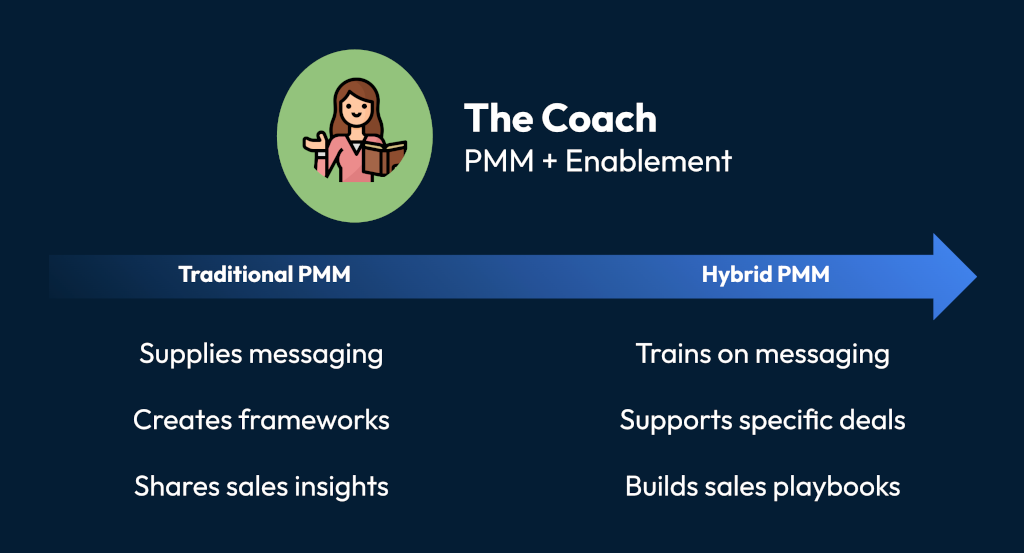
Path #3: The Coach (PMM + Enablement)
Best for: PMMs who love teaching, fieldwork, and cross-functional impact.
Most sales enablement teams today are either:
- Too detached from the product, or
- Too junior to deliver strategic impact.
This is where a PMM can step in and become a massive multiplier for the revenue team.
What this hybrid looks like:
- You spend more time with Sales than you do with Marketing
- You’re the go-to person for competitive differentiators
- You join internal sales meetings regularly as an authority on your market category
How to break in:
- Run a monthly “Positioning in Practice” session
- Work with sales leaders on a win story playbook
- Instead of handing off insights to enablement specialists, do more of the training yourself
How to show your value:
- Create a feedback loop for your training sessions
- Track pipeline and ARR for any deals you supported
- Share wins and learnings back to your Marketing team
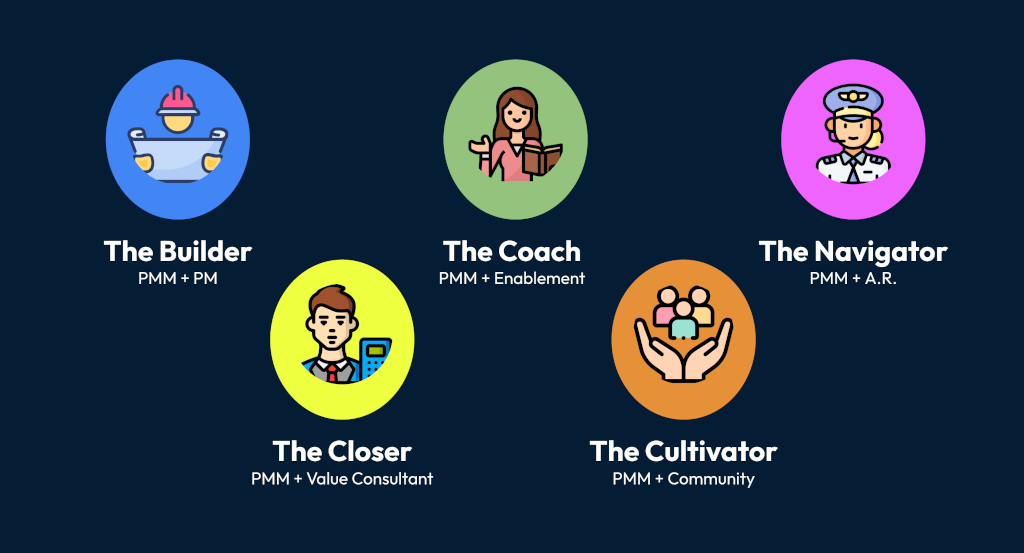
Other hybrid roles for PMMs
The Cultivator (PMM + Community)
Builds love loops, feedback channels, and growth drivers.
Great for PMMs who are empathetic, curious, and want closer ties to customers.
The Navigator (PMM + Analyst Relations)
Shapes how your company and category are perceived externally.
Yes, many PMMs already do this. But if you’re in a company that’s aiming for a Wave or Magic Quadrant, owning this narrative puts you at the center of something strategic.
Pro tip: Use analyst briefings to pressure-test your positioning before you bring it to market.
How to start hybridizing your role
This isn’t about asking for a new title. It’s about acting differently to make a bigger impact than you are today.
1. Pick one path that matches your interest.
- Do you light up when talking about the product? Become a Builder.
- Do you love customer calls and sales psychology? You’re the Closer.
- Do you like coaching and evangelizing? Shoot for Coach.
2. Find a stretch project.
- Help build a business case for an upcoming deal.
- Create a training deck with live customer snippets.
- Lead a “what should we build next?” session for product.
3. Track the impact.
- Did the deal close faster? Bigger?
- Did the training get better adoption?
- Did your product idea make the roadmap?
You don’t need formal KPIs. You just need a good story—and people who can vouch for you.
Don’t wait for permission to become more useful
The role of a product marketer is already changing, and we don’t know how it’ll look in five years. Let’s be honest, company leaders don’t even know what they need today.
So don’t wait for someone to tell you what your future job is going to be.
Find new ways to make an impact, and act on them—whatever your job description says today.
The more surface area you have across product, sales, and customers, the more irreplaceable you become. And while AI might someday generate your battlecards, it’s not going to win a late-stage deal, influence the roadmap, or coach a team through a launch crisis.
That’s on you.
So take the leap. Try something new, even if it scares you.
Because the future won’t belong to the most efficient PMMs—it’ll belong to the most adaptable ones.

